Complete Guide: Mastering Modern Supply Chain & Logistics for Businesses in Indonesia
In today’s fast-paced business world, efficiency and accuracy in managing the supply chain are key to competitiveness. In Indonesia, businesses still face several classic challenges such as high logistics costs, limited infrastructure, and distribution processes that are not yet fully digitalized. However, digital technology now offers concrete solutions to overcome these issues. In this article, we will discuss the current condition of Indonesia’s supply chain, AI- and automation-based solutions, how to calculate logistics losses, and how to prepare for the future of logistics in 2026.
Ongoing Supply Chain Challenges in Indonesia
Indonesia faces a number of complex logistics challenges:
1.High logistics costs: According to the Ministry of Transportation, national logistics costs still account for 23–25% of GDP, far higher than the global average.
2.Uneven infrastructure: Inter-regional connectivity remains a challenge, especially for inter-island shipments.
3.Manual distribution processes: Many businesses still rely on spreadsheets or manual systems, which are prone to errors, delays, and lack real-time capabilities.
If not transformed digitally soon, these challenges will continue to squeeze profit margins and reduce customer satisfaction.
AI as a Predictive Solution to Supply Chain Disruptions
Artificial Intelligence (AI) has opened new possibilities in managing supply chains predictively. AI enables companies to:
1.Monitor demand and supply patterns to prevent stockouts or overstocking
2.Predict disruptions such as supplier delays based on historical data
3.Suggest alternative routes and logistics sources when distribution issues arise
4.Detect potential disruptions such as bad weather or traffic congestion and suggest quick solutions
5.Optimize procurement and distribution based on actual market demand forecasts
AI implementation also allows businesses to make faster, real-time data-driven decisions rather than relying on assumptions. This is crucial for maintaining supply chain resilience, especially amid market uncertainties.

Warehouse Automation: Turning Stock into Operational Strength
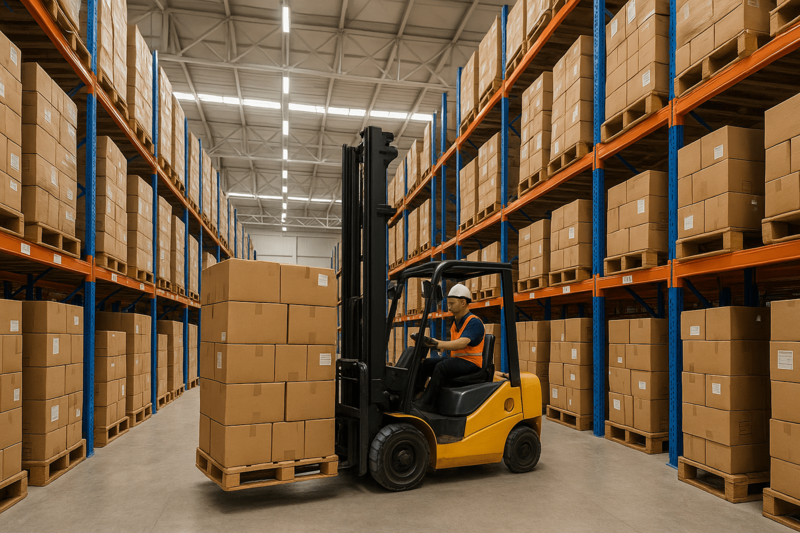
A modern warehouse is no longer just a storage area. With automation, the warehouse becomes a hub of efficiency. Some of its advantages include:
1.High accuracy: Technologies such as barcodes and RFID minimize record-keeping errors.
2.Faster picking & packing: Warehouse Management Systems (WMS) and automation accelerate the process.
3.Real-time monitoring: Visual dashboards enable full control of stock movements.
Automation also enhances business flexibility in handling demand surges, especially during seasonal events such as Eid or Harbolnas (Indonesia’s national online shopping day).
Smart Route Planning Systems for Delivery Optimization
Optimizing deliveries is not just about time, but also about fuel and cost efficiency. Tech-based route planning systems offer:
1.Fastest routes based on real-time traffic data
2.Fuel-efficient route simulations considering topography and vehicle type
3.Automated notifications to customers regarding delivery time estimates
This improves customer experience and significantly reduces operational costs for businesses.
Calculating Logistics Losses & Determining the ROI of Technology
Logistics losses often don’t show up directly in financial reports. However, their impact can be significant on profitability. Several forms of loss to identify include:
1.Overstocking due to inaccurate demand forecasting
2.Returns or shipping errors due to manual recordkeeping
3.Operational downtime due to non-integrated systems
4.Customer loss due to delivery delays or slow service
Once losses are identified, the ROI (Return on Investment) of implementing supply chain technology can be calculated. Here's how:
1. Calculate Total Technology Investment
Start by collecting all costs related to tech implementation, such as:
1.Software costs (licenses, subscriptions, or custom development)
2.Hardware costs (scanners, IoT sensors, servers, etc.)
3.Staff training and adoption time
4.Integration costs from old systems to new systems
Example:
If you implement an automated Warehouse Management System (WMS) worth IDR 300 million, that is your initial investment.
2. Identify Efficiency Gains Post-Implementation
Analyze before and after system implementation to calculate savings or performance gains, such as:
1.Reduced labor costs → For example, reducing 2 warehouse staff (saves IDR 8 million/month)
2.Fuel savings from more efficient routes → e.g., saves IDR 2 million/month
3.Reduced returns due to automated pick & pack systems → e.g., saves IDR 5 million/month
4.Faster order processing → e.g., 20% faster, enabling more orders (increased revenue)
3. Simple Formula to Calculate Technology ROI
Use this formula:
ROI (%) = [(Total Benefit – Total Investment) / Total Investment] x 100
Example:
1.Total annual benefit from efficiencies:
2.IDR 8M (labor) + IDR 2M (fuel) + IDR 5M (returns) = IDR 15M/month → IDR 180M/year
3.Initial investment: IDR 300M
Conclusion:
ROI = [(180M – 300M) / 300M] x 100 = -40% (loss in the first year)
But in the second year (with no new investment), the benefit remains IDR 180M, so:
Year 2 ROI = 180M / 0 → Net savings.
This means the system breaks even between year 2 and 3 and provides pure profit afterward.
4. Add the Intangible Dimension (Indirect Gains)
Besides measurable figures, consider indirect impacts such as:
1.Increased customer satisfaction → loyalty and repeat orders
2.Enhanced business competitiveness through faster delivery
3.More transparent data for strategic business decisions
4.Easier scalability as systems are already future-ready
Though hard to quantify in currency, these factors are highly influential in the long run.

Is Your Warehouse Ready for 2026 and Market Shifts?
Future logistics trends will demand even greater flexibility and supply chain resilience. To prepare for 2026 and the evolving market, your warehouse must be:
1.Scalable: Ready to adjust capacity when demand spikes
2.Data-driven: All recording, stock, and shipping processes must be digitized
3.Integrated: Warehouse systems must connect with ERP, e-commerce, and delivery services
Digital warehouse transformation is not optional—it’s the foundation of future business competitiveness.
Conclusion
Modern supply chain and logistics require smarter, more efficient, and proactive approaches. From infrastructure challenges to supply chain disruption risks, solutions like AI, warehouse automation, and smart route planning have proven to be game-changers. Companies that adapt to technology will lead in distribution speed, cost efficiency, and customer satisfaction. Don’t wait until your manual systems become a burden—start your logistics transformation today.
Integrated Digital Logistics Solutions with Smart IT
It’s time for your business to have a logistics system that is efficient, transparent, and quickly adaptable to change. Smart IT is ready to help you build AI-powered solutions, warehouse management systems, and custom delivery route systems tailored to your needs. Contact us today and begin your supply chain transformation journey!
PT SMARTIT MANTAP DIGITAL INDONESIA
Vieloft Ciputra World, Suite 10-01.
Kompleks Superblock, Ciputra World
Jl. Mayjen Sungkono No.89 Surabaya, Jawa Timur, Indonesia 60224
Telepon: +6281130576888 / +628113426391
Email: hello@smart-it.co.id
Facebook: Smart IT Indonesia
Linkedin: Smart IT Indonesia
Instagram: smartitcoid
Related Articles
 Logistic
Reduce Human Error in Warehousing and Logistics with a Combination of Software and Skilled Human Resources
 Logistic
The Real Cost of Inefficient Logistics in Indonesia and How to Calculate Your Custom Automation ROI
 Cloud and DevOps